The Middleware Layer of the Multi-Model Era: How Gate.AI Becomes a Unified AI Gateway for Enterprises
In 2026, artificial intelligence is moving from a "model capability race" into a new phase: a competition for "infrastructure efficiency." Global tech companies have collectively spent over $60 billion on AI infrastructure. Meanwhile, the AI inference gateway market is expected to grow from $2.71 billion in 2025 to $3.5 billion in 2026, a 29.2% CAGR. The large-scale influx of capital and the rapid expansion of the market point to one clear conclusion: the way enterprises deploy AI is fundamentally changing.
Over the past two years, most companies have focused on "AI from 0 to 1." They pick a model, integrate an API, and get a single use case working. But in 2026, the reality is that enterprises no longer face the question of "whether to use AI," but rather "how to manage AI." A single company might use a large language model for text, an image model for visual tasks, and an audio model for voice interactions. Each model has its own independent API, billing method, and data flow. This fragmentation is becoming the biggest obstacle to scaling AI deployments across enterprises.
Gate.AI was launched precisely in this context as an enterprise-grade AI infrastructure service. It is not a new AI model. Instead, it is a unified access platform positioned at the application layer between enterprises and model providers—an AI gateway platform that helps build a unified AI entry point. With a single API, enterprises can access 200+ mainstream models worldwide and complete calls, routing, cost control, and permission management under a unified governance framework.

AI fragmentation: the hidden barrier to enterprise-scale deployment
To understand the value of Gate.AI, you first need to understand the real dilemmas enterprises face when rolling out AI.
First is interface fragmentation. Different model providers offer different API protocols, different parameter specifications, and different response formats. Each time a new model is integrated, the development team must rewrite integration code, retest and debug the interface, and re-handle exceptions. This duplicated effort not only wastes engineering resources, but also extends the timeline for business rollout.
Second is cost invisibility. When a company uses multiple models, each one has different billing units, different unit prices, and different usage distributions. The finance team can’t answer even the simplest question: How much did AI cost last month? Which models did that money go to? Which business scenarios consumed the most Tokens? Without unified billing and usage attribution, AI spending remains a "black box."
Third is loss of control over permissions and data security. When different departments and teams each request their own API Keys and call models on their own, the company lacks unified governance over how AI is used. Who is calling which models, how much they’re calling, and where the data goes—these key details are hard to track. For enterprises handling sensitive business data, whether model providers retain data and how that data is used is an equally uncertain and serious risk.
These issues are not unique to any one company. They are structural challenges that inevitably emerge as AI moves from "pilot projects" to "scale." Gate.AI is positioned to address this by building a unified AI entry point and bringing scattered model calls under a single management system.
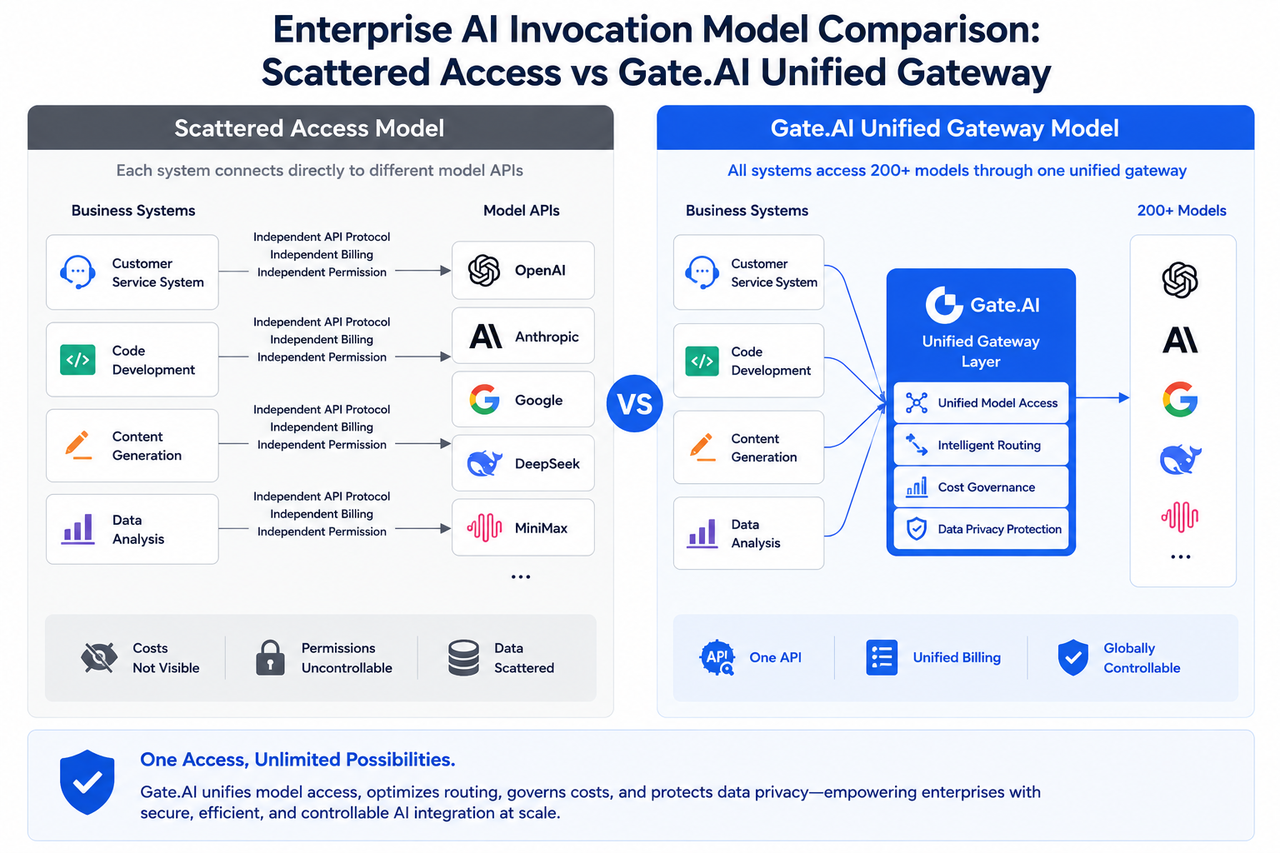
Enterprise AI call patterns: fragmented access vs Gate.AIunified entry point
Unified model access: one API covering 200+ mainstream models
Gate.AI provides the first layer of infrastructure for a unified AI entry point for enterprises: a unified model access layer.
Source:Gate.AI
Enterprises don’t need to apply for an API and write integration code for each model separately. With a Gate.AI API Key, they can call 200+ mainstream global models, including GPT, Gemini, Claude, Nemotron, DeepSeek, MiniMax, Qwen, MiMo, Kimi, GLM, ChatGLM, and Grok. The platform is compatible with both the OpenAI and Anthropic protocols. That means existing business code doesn’t need to be rebuilt to migrate.
For enterprises that have already built applications using OpenAI or Anthropic SDKs, integrating Gate.AI takes just three steps: create an API Key in the console, top up Credits, and replace the Base URL and API Key in your code with Gate.AI’s configuration. Your existing business logic, parameter structures, and response handling remain unchanged.
In addition, Gate.AI also supports popular development frameworks and IDE tools such as LangChain, LangGraph, LlamaIndex, Cline, Cursor, Codex, and Claude Code. No matter what technical stack your enterprise uses, you can integrate without changing your development habits.
Smart routing: match the best model for every call
Unified model access solves the "how to connect" problem. But a unified AI entry point must also answer another question: among multiple available models, how should the system choose the best model for each specific task?
Gate.AI’s built-in smart routing was designed for exactly this. Routing decisions consider multiple metrics, including model performance, response latency, call cost, and real-time availability. When multiple models can achieve the same task, the system can prioritize the lower-cost option. If a model service is delayed or unavailable, an automatic fallback mechanism switches the request to a backup model to keep service running reliably.
For enterprises, the value of smart routing isn’t just "convenience." It’s also "saving money" and "reducing hassle." Developers don’t have to manually determine which model to use for every request, and they don’t need to switch temporarily when a model service has issues. Routing logic is handled automatically by the platform. Callers always interact with a unified API interface, while behind the scenes the system dynamically optimizes model scheduling.
Cost governance: make every AI expense clear and traceable
Another core capability of a unified AI entry point is cost governance.
Gate.AI uses a pre-paid Credits, pay-as-you-go billing model with no fixed monthly fee and no minimum spend requirement. The platform stays in sync with the official prices of each model. The price shown on the page is the actual settlement price, with no markups. For models that support caching, input Tokens that hit the cache are billed at the official cached discount price. Tokens that miss cache are billed at the original rate.
More importantly, Gate.AI provides enterprises with unified billing and budget control. Cross-model usage analytics and cost attribution help companies clearly understand where every AI dollar goes—what team made the calls, which models were called, how many Tokens were consumed, and how much was spent. This transparency turns AI costs from "hard-to-track variables" into a "measurable and optimizable" management object.
For enterprise customers with high usage volumes, Gate.AI offers the Enterprise Edition with customized volume-based pricing discounts and annual contracts. Payment methods include bank cards, Web3 payments, and enterprise-to-enterprise payments, and it provides invoices.
Data privacy protection: enterprises have full control
Data privacy is an unavoidable compliance topic for enterprises when building a unified AI entry point.
Gate.AI by default does not store users’ input prompts or output content. By default, the platform does not use any user data for product improvement plans. Users can independently choose whether to enable log retention, and they can also choose to proactively authorize product improvements to receive specific request-price discounts.
For enterprise customers with even higher requirements for data privacy, Gate.AI Enterprise Edition offers a ZDR (Zero Data Retention) solution that eliminates the risk of sensitive data leakage at the source. It also comes with dedicated data processing agreements to ensure protection. Enterprises retain complete control over data privacy.
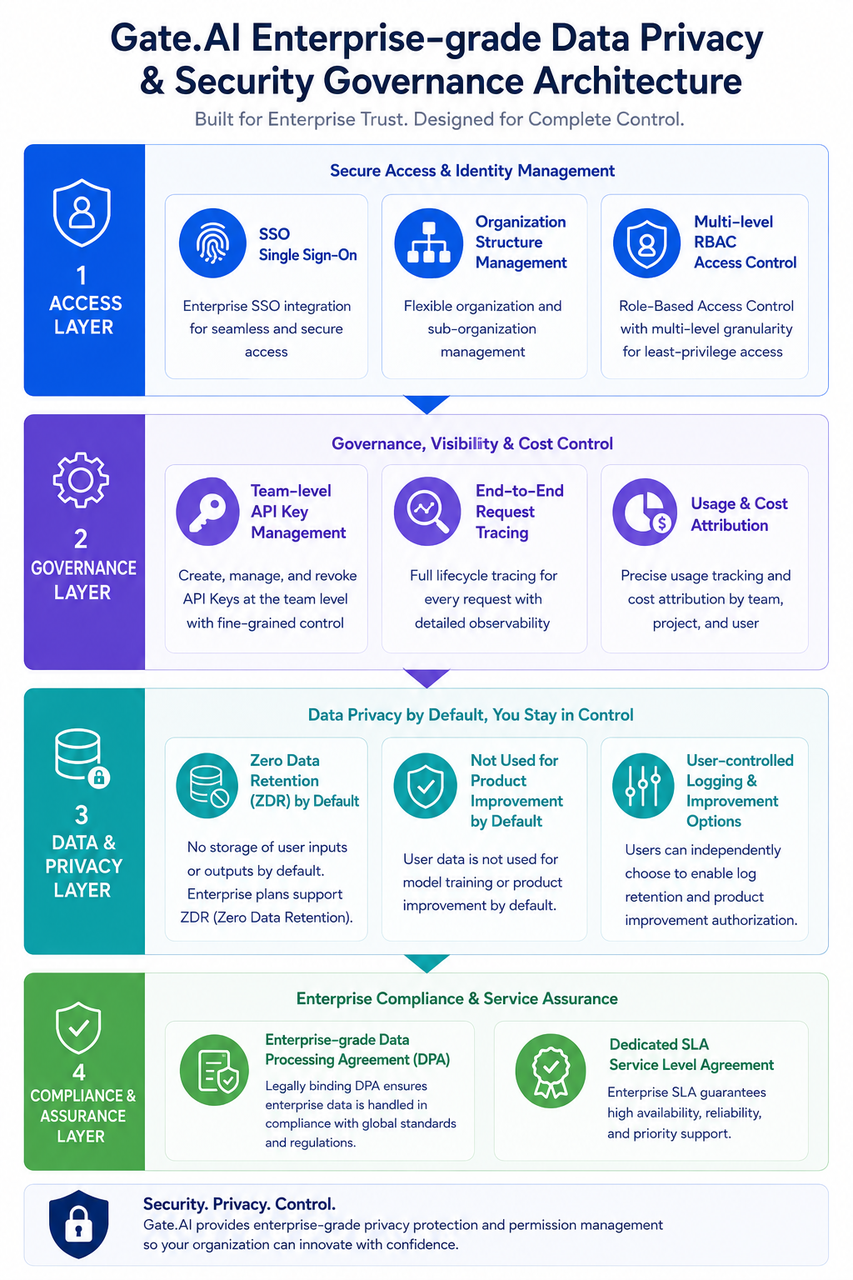
Gate.AIEnterprise-grade security and privacy protection architecture diagram
Organizational permission controls: unified AI usage management at the team level
As AI usage expands from one department to the entire company, organizational permission governance becomes a rigid requirement for a unified AI entry point.
Gate.AI supports team-level API Key management, role-based permission control, and end-to-end call tracing. The Enterprise Edition supports SSO login. It also provides organizational structure management and multi-level role-based access control, enabling unified access across multiple teams and departments with fine-grained permission isolation.
This means enterprises can assign different API Keys to different teams, set different call quotas, and view different usage breakdowns. Who is calling, what they’re calling, and how much they’re spending—full end-to-end visibility and traceability.
Why the market needs an AI gateway platform
The enterprise unified AI entry point model represented by Gate.AI is not an isolated product innovation. It responds to a market need that is accelerating in pace.
According to market research, the market size for large language model gateway platforms is expected to grow from $3.34 billion in 2025 to $4.23 billion in 2026, with a 26.7% CAGR. The AI inference gateway market is expected to grow from $2.71 billion in 2025 to $3.5 billion in 2026. Behind these numbers is the urgent demand from enterprises for unified model access, unified cost governance, and unified security governance.
In 2026, the AI industry is transitioning from a "model capability-driven stage" to a "compute orchestration and efficiency-driven stage." Enterprises are no longer satisfied with "having AI." They want to "use AI well"—controlling costs while ensuring performance, keeping security boundaries intact while expanding applications, and establishing auditable and traceable governance as they accelerate innovation.
The positioning of Gate.AI is exactly the infrastructure service needed at this turning point.
Conclusion
From unified model access to smart routing, from cost governance to data privacy protection, and from organizational permission controls to unified governance, Gate.AI provides enterprises with a complete path to build a unified AI entry point. Enterprises don’t need to integrate with the APIs of dozens of model providers one by one. They don’t need to set up separate ledgers for each model’s billing method. And they don’t need to juggle multiple permission systems.
One API covers 200+ mainstream models. One governance system unifies usage, permissions, and costs. Enterprises can focus on business innovation itself, instead of being consumed by the complexity of AI infrastructure.
Gate.AI doesn’t provide yet another model. It delivers a scheduling and management system that unlocks greater commercial value from existing models. For enterprises looking to take AI from fragmented pilots to scaled deployment in 2026, this may be the missing middle layer.


