GPT, Claude, Gemini, DeepSeek, or Gate.AI: How to Choose? A Guide to Enterprise AI Model Selection and Intelligent Routing

The large language model market in 2026 is undergoing a profound structural transformation.
According to Sensor Tower’s "2026 AI Status Report," OpenAI’s ChatGPT saw its market share drop to 46.4% by the end of May 2026, ending its dominance of over 50% since January 2026. Google’s Gemini has rapidly closed the gap, reaching a 27.7% share, while Anthropic’s Claude has climbed to 10.3%. Meanwhile, open-source models like DeepSeek have secured a foothold in the global market with their low-cost advantages.
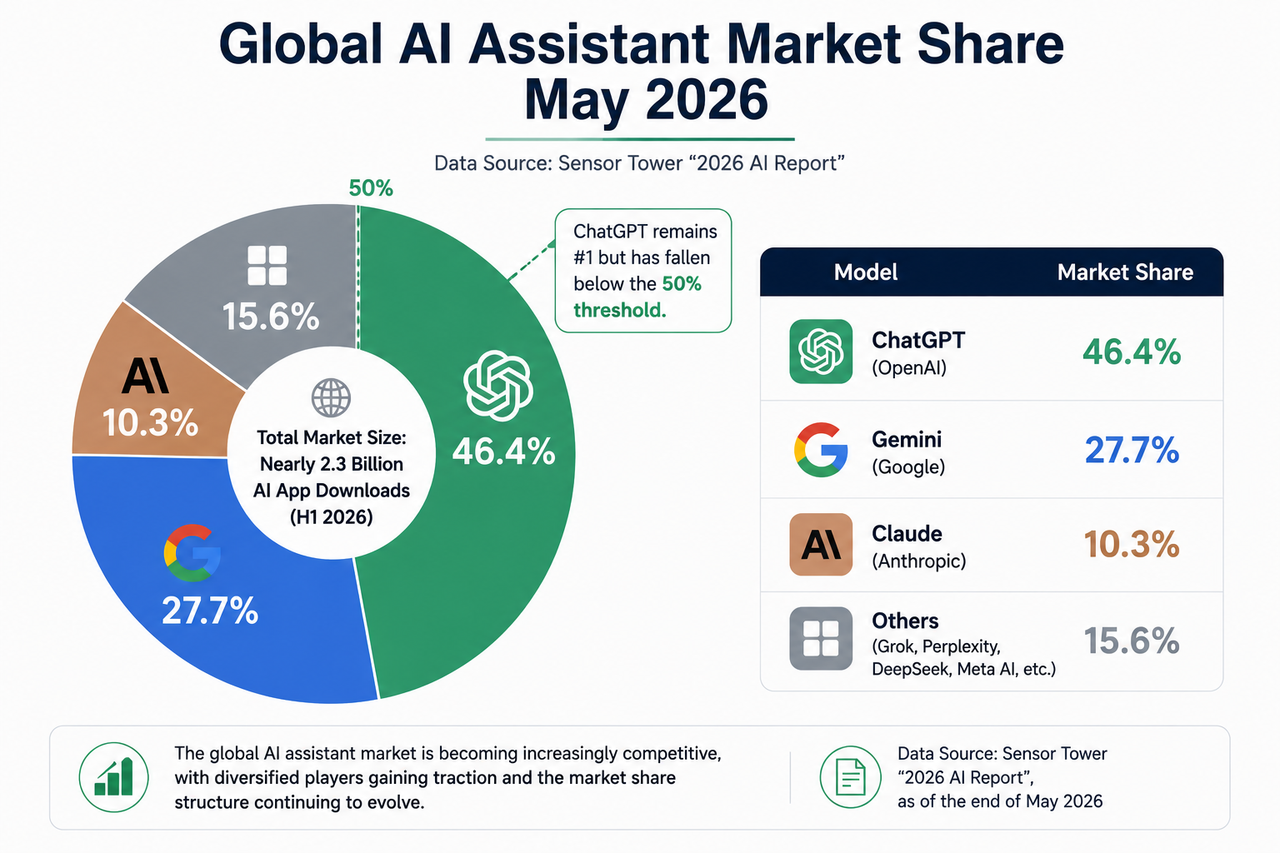
Global AI Assistant Market Share, May 2026
As the market landscape diversifies, businesses now face more—and more complex—choices than ever when selecting AI models.
For enterprise decision-makers, the question has shifted from "Should we use AI?" to "Which model should we use, and how?" GPT, Claude, Gemini, and DeepSeek each offer distinct advantages, but no single model leads across all tasks. This article analyzes key factors such as model capabilities, cost structures, and applicable scenarios to provide a decision framework for enterprise AI model selection.
Model Selection: Differentiated Positioning of Four Leading Models
GPT: General-Purpose Capabilities and Ecosystem
Developed by OpenAI, the GPT series is one of the most widely adopted model families on the market. Its core strengths lie in robust general reasoning and a mature ecosystem.
In terms of API pricing (based on 2026 market rates), GPT-4.1 is priced at $2.00 per million tokens for input and $8.00 per million tokens for output, with a 1M token context window. The higher-performance GPT-5.5 Pro commands an output price of $180 per million tokens.
GPT models excel in coding tasks. The o3 model scored 95.2 on the HumanEval benchmark, leading its generation. GPT-5.5 stands out in agent coding and tool use. Enterprises can deploy GPT for code generation and review, complex logical reasoning, and multi-turn conversational systems.
For businesses needing rapid deployment and high generalization, the GPT series is a reliable choice. However, for large-scale, cost-sensitive applications, it’s crucial to assess whether API pricing fits within budget constraints.
Claude: Long-Form Understanding and Security Compliance
Anthropic’s Claude series differentiates itself with strengths in long-text processing and safety alignment.
The Claude product line covers multiple tiers. Claude Haiku 4.5 is priced at $1.00 per million tokens for input and $5.00 for output. Claude Sonnet 4.5 is $3.00 for input and $15.00 for output. Claude Opus 4.5 is $5.00 for input and $25.00 for output, with a 200K token context window.
Claude models deliver balanced performance in benchmarks. Claude Opus 4.5 scored 89.5 on MMLU and 9.3 on MT-Bench. Claude Sonnet 4.5 achieved a HumanEval score of 93.0.
Claude has built a strong reputation in productivity scenarios, with user retention rates approaching ChatGPT. In June 2026, Anthropic launched Claude Fable 5 and Mythos 5—Fable 5 targets developers and enterprise knowledge work, while Mythos 5 focuses on high-sensitivity scenarios like cybersecurity and infrastructure.
For enterprises handling long document analysis, contract review, or research reports, Claude’s extended context and safety features offer clear advantages. Claude Enterprise also provides management controls like SSO and domain capture.
Gemini: Multimodal and Agent Capabilities
Developed by Google, the Gemini series has established technological barriers in multimodal understanding and agent capabilities.
In May 2026, Google officially released the Gemini 3.5 series, integrating advanced intelligence with powerful action capabilities. Gemini 3.5 Flash delivers output speeds four times faster than comparable leading models, at less than half the price.
Pricing for Gemini 2.5 Pro is $1.25 per million tokens for input and $10.00 for output. Gemini 2.5 Flash is $0.30 for input and $2.50 for output, with a 1M token context window.
Enterprise adoption of Gemini is accelerating. In Q1 2026, Gemini Enterprise’s paid monthly active users grew 40% quarter-over-quarter, and its API processed over 16 billion tokens per minute. Google positions the Gemini Enterprise Agent Platform as the "mission control center" for building enterprise AI agents.
For businesses working with images, video, audio, or planning to build AI agents, the Gemini series offers a comprehensive technology stack.
DeepSeek: Open Source and Cost Efficiency
Developed by DeepSeek, this model family has rapidly gained global traction through its open-source approach and highly competitive pricing.
In April 2026, DeepSeek released the V4 series with 1.6 trillion parameters, native support for million-token context, and full open-source availability under the MIT License. The series includes Pro and Flash versions: Pro leads in agent and reasoning performance, while Flash offers fast inference and low costs—ideal for high-concurrency scenarios like large-scale customer support.
Pricing for DeepSeek V3 is $0.25 per million tokens for input and $1.10 for output. DeepSeek R1 is $0.55 for input and $2.19 for output.
On benchmarks, DeepSeek R1 scored 90.8 on MMLU and 97.3 on MATH. DeepSeek V4’s agent capabilities reached best-in-class among open-source models in Agentic Coding evaluations.
For cost-sensitive enterprises, those requiring private deployment, or those with open-source compliance needs, DeepSeek is an attractive option. Its API is compatible with OpenAI and Anthropic interfaces, reducing migration barriers.
From "Choosing One" to "Managing Many": A Paradigm Shift in Enterprise AI Architecture
Enterprise AI deployment in 2026 is undergoing a fundamental shift.
Currently, about 69% of enterprises use three or more AI models in production, and the number using six or more has nearly doubled year-over-year. On average, enterprises rely on seven AI models.
This trend is driven by clear business logic: code generation requires strong reasoning, long-text processing depends on stable context retention, and multimodal understanding needs cross-modal alignment. No single model excels across all dimensions.
At the same time, API pricing differences between models can reach several hundredfold. For a simple intent recognition task, using a flagship model might cost hundreds of times more than a lightweight model, with nearly identical output quality. Conversely, assessing the risk of a 50-page legal contract is beyond lightweight models, requiring top-tier reasoning models.
This means businesses don’t need "the best model," but rather an intelligent scheduling system that matches the right model to each task automatically.
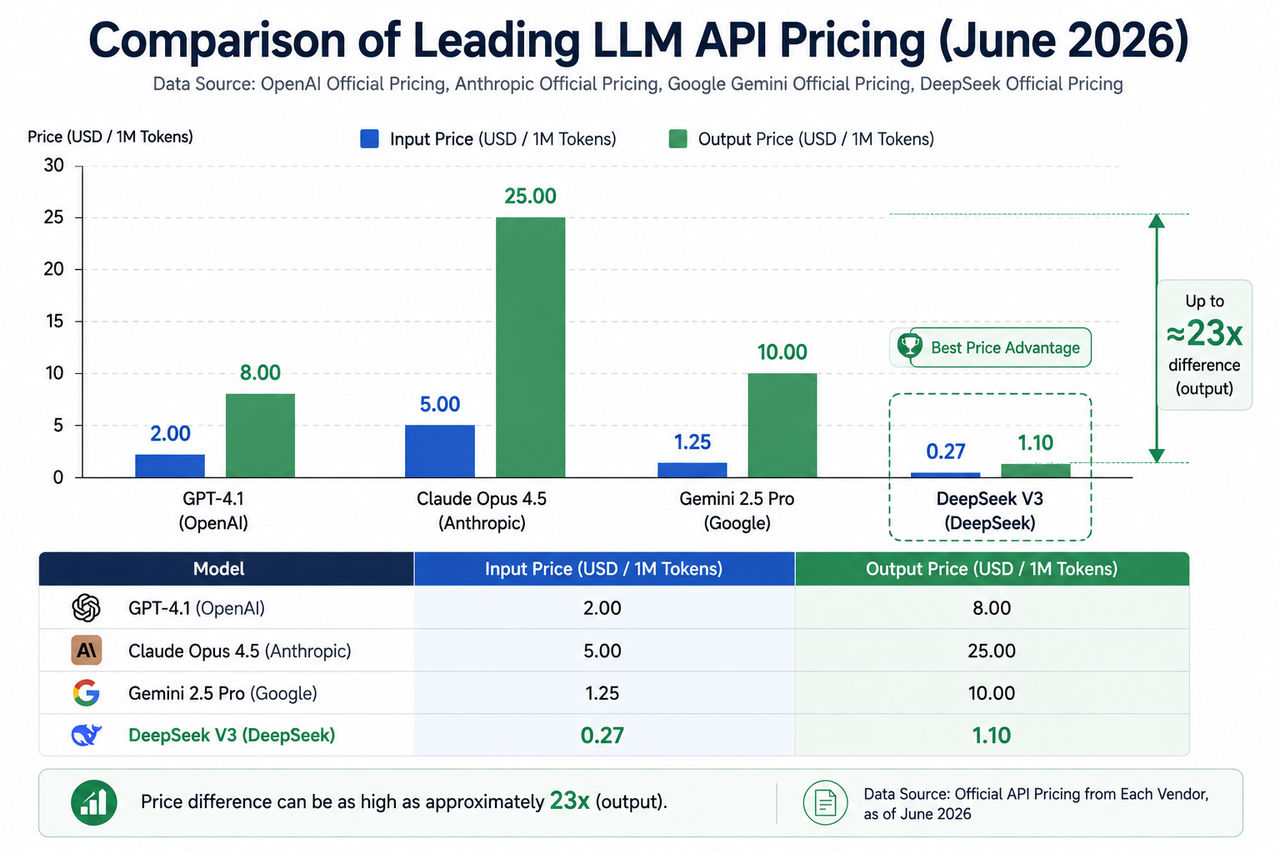
API Pricing Comparison of Leading Large Language Models (June 2026)
Gate.AI: Unified Access and Intelligent Routing for Enterprises
Gate.AI is designed to address these needs—not as a new model, but as a unified access and intelligent routing platform between applications and model providers.
Unified Access: One API for 200+ Models
Developers can simply create an API key in the Gate.AI console and replace their application’s endpoint with Gate.AI’s unified gateway to access over 200 leading models through a single interface. Coverage includes OpenAI, Anthropic, Google, Meta, xAI, DeepSeek, Alibaba, Zhipu, and other major global AI vendors.
Gate.AI natively supports the OpenAI and Anthropic API protocols, so existing code based on these protocols requires no refactoring during migration. It integrates seamlessly with popular frameworks like LangChain, LangGraph, LlamaIndex, Cursor, and Claude Code.
Intelligent Routing: Automatic Model Selection
Gate.AI Auto Routing is an intelligent model routing mechanism. Developers don’t need to specify a model manually—by setting model=auto in the request, the system automatically selects the most suitable model for the task.
The system evaluates request complexity, context length, response speed requirements, and the current status of each model. It continuously monitors real-time metrics like latency, error rates, rate limits, and available capacity. If a model is under heavy load, the system redirects requests to other available models.
If the current model fails to complete a request, the system automatically reroutes to another available model—no manual intervention required. This intelligent fallback mechanism significantly reduces the risk of single points of failure affecting business systems.
Enterprise Governance: Unified Control of Cost, Security, and Permissions
Gate.AI provides full-chain call visualization and tracking, giving enterprises clear visibility into every AI expenditure. The platform has no fixed monthly fees or minimum consumption requirements; it uses a prepaid, pay-as-you-go model.
For data privacy, Gate.AI does not retain user data by default or use it for product improvement. Enterprises can configure log retention as needed. The enterprise edition supports Zero Data Retention (ZDR), eliminating sensitive data leakage risks at the source.
In terms of access control, the enterprise edition supports SSO login, organizational management, and multi-level, role-based permissions—enabling unified access and granular isolation for multiple teams and departments.
Conclusion
The 2026 AI model market has made one thing clear: No single model can do it all. GPT leads in general reasoning and coding, Claude excels in long-text processing and compliance, Gemini is ahead in multimodal and agent capabilities, and DeepSeek carves out a differentiated path with open source and cost efficiency.
For enterprises, the real challenge isn’t "which model to choose," but how to flexibly orchestrate the most suitable model for each scenario and task—while controlling costs, ensuring data security, and maintaining service stability. Gate.AI delivers a comprehensive management solution through unified access, intelligent routing, and enterprise governance, making enterprise AI integration safer, more stable, and more controllable.


